

The Giro d’Italia isn’t racing this Monday, but it isn’t resting either. The race’s first break is, in fact, a massive relocation.
After three stages in Bulgaria, the entire caravan packs up to return to Italy: riders, teams, organizers, media, buses, trucks, bikes, and all the equipment that sustains the Corsa Rosa daily.
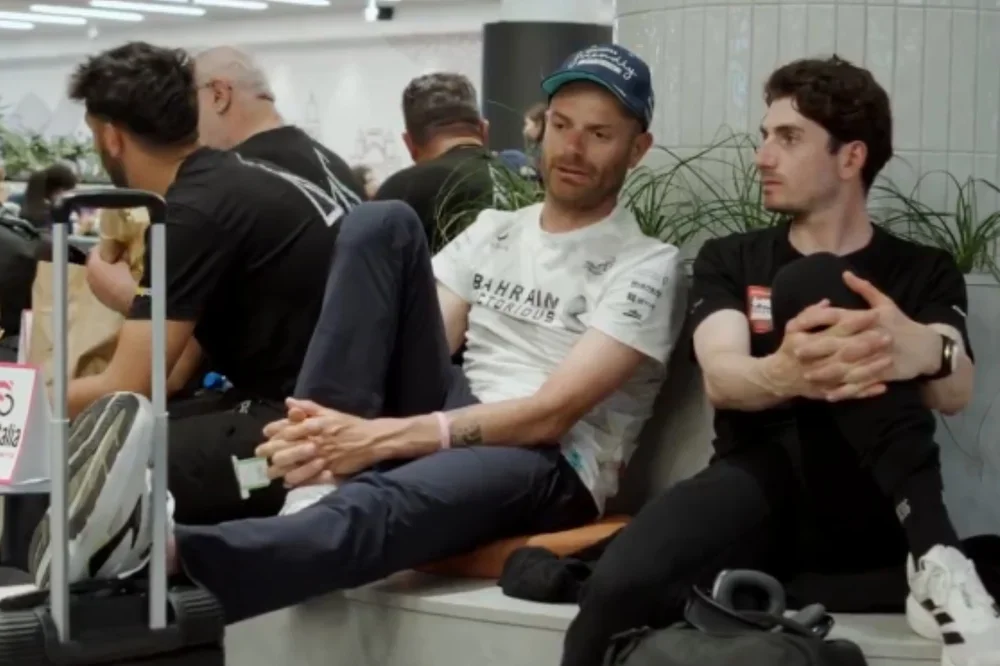
The Grande Partenza in Bulgaria has set aside an entire day for transportation. The peloton leaves the Black Sea and the streets of Sofia to land in Calabria, with Catanzaro as the meeting point before Tuesday’s stage. This isn’t a typical rest day of hotel, massage, and legs up. It’s a day of airports, roads, and logisitics pushed to the limit.
Most riders, including Jonas Vingegaard, took a flight from Sofia on Sunday evening to save time and reduce the impact of the move. Still, the Dane didn’t hide his discomfort before heading to the airport. “I would have preferred to skip that trip, and I brought my mask and hand sanitizer,” he told the media.
For cyclists, the journey is the easiest part of the chaos. The real blow falls on the staff. The main buses, team vehicles, and a large portion of the equipment face an enormous transfer by road, ferry, and plane. Six countries, roughly 3,400 kilometers of accumulated logistics, and at least 19 hours of driving from Sofia to southern Italy. Not all teams have a second bus waiting for them at the destination. They must arrive, set up, organize, and have everything ready so that on Tuesday, the race can return to normal.
This early break responds to that need. As happened in 2022, with a start in Hungary, and in 2025, with Albania, the Giro places its first rest day after just three stages to return to Italian soil. The explanation is simple. The challenge is executing it without the race suffering.
Calabria awaits the peloton. The competition resumes this Tuesday, May 12, with stage 4, between Catanzaro and Cosenza, over 144 kilometers. A winding profile, with Italian flavor, could open the door to breakaways or a reduced sprint due to its uphill finish. The peloton arrives with heavy legs after the Bulgarian trilogy, where Paul Magnier won the third stage and UAE suffered the harsh consequences of a terrible crash.
The Giro will have another long move before it ends. After stage 20, finishing in the northern mountains at Piancavallo, the caravan will have to head down to Rome for the final sprint stage. That’s about six hours by road, and many riders will likely take a plane again before the race wraps up.
