

The 2025-26 NBA Draft has concluded, with the Washington Wizards and Los Angeles Clippers emerging as major winners. The Clippers’ mid-season trade that sent two players for five assets proved highly profitable, netting them young star Bennedict Mathurin, two first-round picks, and a second-round selection. The Indiana Pacers, after tanking all season, ended up with the fifth pick, which ultimately landed with the Clippers – a wasted effort for Indiana. The Wizards, defying 14% odds to win the lottery, surprisingly showed little excitement. Their front office indicated they already have key pieces like Trae Young and Anthony Davis, along with young contributors, and are not keen on using the top pick on a future cornerstone. Instead, they prefer to trade down.
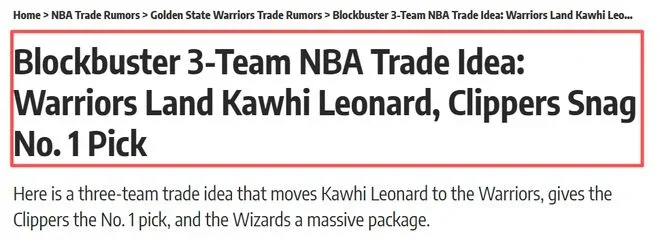
Meanwhile, the Golden State Warriors secured the 11th pick in the draft. After re-signing head coach Steve Kerr and reaffirming their championship aspirations over the next 2-3 years, the Warriors are targeting a veteran star to support Stephen Curry this summer. The 11th pick could be a key trade chip. According to sources from Bleacher Report, the Warriors, Wizards, and Clippers could reach an epic three-team deal before the draft. The proposed framework is as follows:
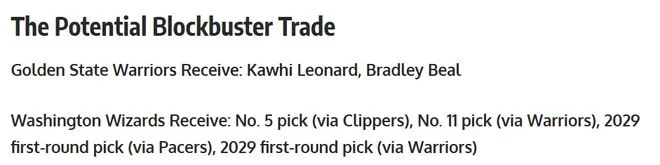
– **Golden State Warriors receive:** Kawhi Leonard and Bradley Beal.
– **Washington Wizards receive:** The Clippers’ No. 5 pick, the Warriors’ No. 11 pick, the Pacers’ unprotected 2029 first-round pick (via Clippers), and the Warriors’ unprotected 2029 first-round pick.
– **Los Angeles Clippers receive:** The Wizards’ No. 1 overall pick, Jimmy Butler, and Brandin Podziemski.
**Why the Warriors Are Going All-In on Kawhi Leonard**
The Warriors’ motivation is straightforward: Kawhi Leonard is far superior to Jimmy Butler at this stage. Golden State isn’t just looking for a scorer; they need a premier second option alongside Curry to elevate their playoff ceiling. Leonard played 65 games this season, averaging 27.9 points, 6.4 rebounds, 3.6 assists, 1.9 steals, and 0.4 blocks, with shooting splits of 50.5% from the field, 38.7% from three, and 89.2% from the line, good for a 62.9% true shooting percentage. He remains a top-tier offensive force. In contrast, Butler managed only 38 games for the Warriors, averaging 20.0 points, 5.6 rebounds, 4.9 assists, and 1.4 steals, but his season was cut short by an ACL tear, raising concerns about his future reliability.
With Curry’s prime window narrowing, the gap between Leonard and Butler is too significant for a contender to ignore. Bradley Beal, after a season of recovery, could bounce back and serve as a backup ball-handler and playmaker, no longer needing to carry a superstar load. The Warriors’ cost is steep: Podziemski, who played all 82 games and averaged 13.8 points, 5.1 rebounds, and 3.7 assists on 45.5% shooting (37.1% from three), is a 23-year-old on a cheap contract through 2026-27. Pairing him with the 11th pick and a 2029 first-rounder is painful, but if Leonard stays healthy, he could be the postseason closer the Warriors need.
**Why the Clippers Make This Deal**
Complete rebuilding is better than stagnating. The Clippers finished 42-40 this season, barely making the play-in tournament despite Leonard playing at near-MVP level. This signals a hard ceiling. The trade gives Los Angeles the No. 1 pick, Podziemski, and Butler. With the top pick, they can select the highest-ceiling prospect in the draft, likely AJ Dybantsa, who averaged 25.5 points, 6.8 rebounds, and 3.7 assists at BYU on 51.0% shooting. He could become the franchise cornerstone. Podziemski is a proven NBA guard on a cost-controlled contract, offering excellent rebounding and playmaking without needing heavy usage. Butler, with one year left on his deal, provides immediate on-court value and veteran mentorship, preventing a toxic losing culture while the young core develops.
**Why the Wizards Give Up the No. 1 Pick**
Washington is poised to contend next season with Trae Young and Anthony Davis. This raises expectations and shifts their draft needs from pure upside to win-now depth and cost-controlled contracts. In the 2026-27 season, Davis will earn $58.5 million, and Young (if he picks up his option) will make $49 million – a combined $107.4 million that leaves little cap flexibility. Adding expensive veterans is impractical. This trade is ideal: they swap the top pick for the No. 5 pick, the No. 11 pick, the Pacers’ 2029 first-rounder, and the Warriors’ 2029 first-rounder. They keep a top-five selection in a strong draft, add another lottery pick, and secure two valuable future first-rounders.
The No. 5 pick can land a playoff-ready piece to complement Young and Davis, while the No. 11 pick adds another young, cheap contributor. With the 2026 class considered deep, the drop-off from No. 1 to No. 5 is not huge, making this a pragmatic move to multiply assets. For a team with tight finances and immediate pressure to win, this deal allows the Wizards to bolster their roster without breaking the bank.
Is this three-team trade a win for all sides? The Warriors bet on another championship run, the Clippers jumpstart a rebuild with a top pick, and the Wizards turn a single asset into multiple building blocks. What do you think?
